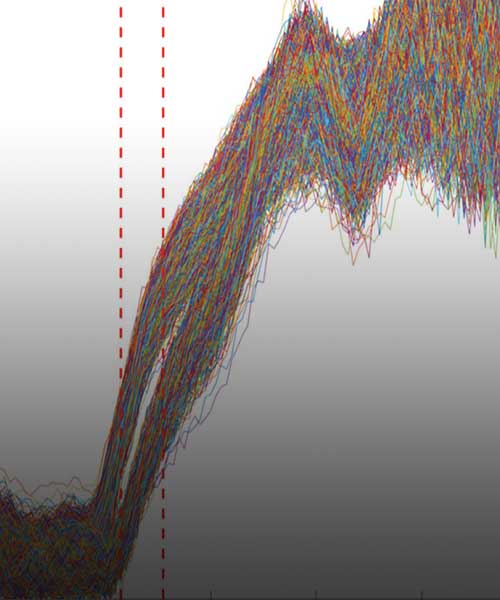
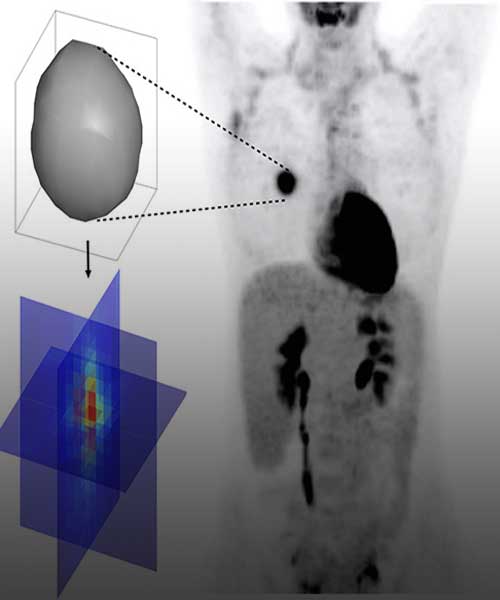
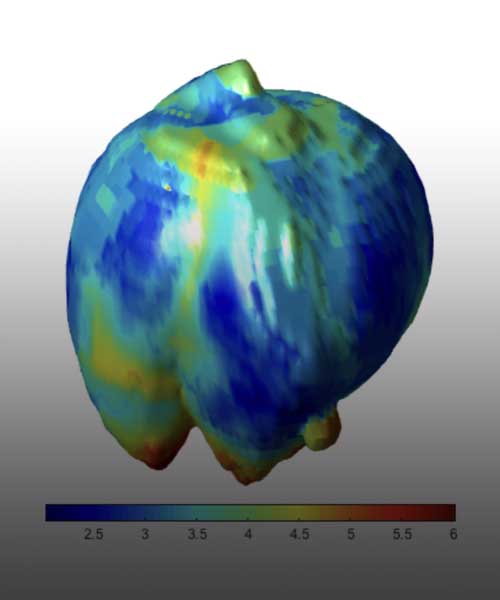
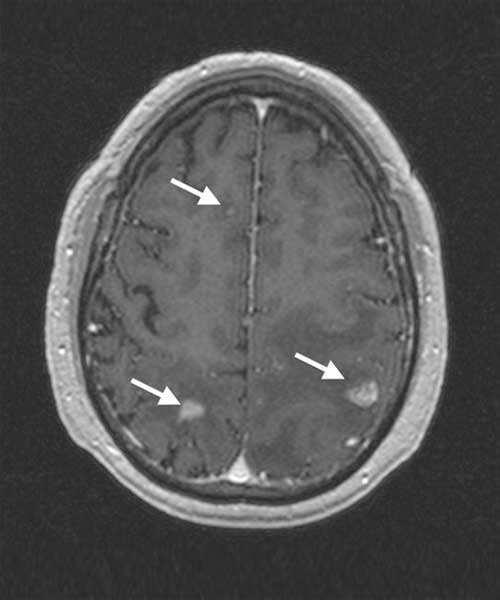
Imaging Biomarkers in Glioblastoma Imaging Biomarkers in Glioblastoma Glioblastoma is the most frequent and aggressive primary brain tumor. We study glioblastoma morphology in medical images to predict survival and personalize treatments. Learn More > Big data and biomarker design Big data and biomarker design Different types of explorations provide a plethora of data from cancer patients. Mathematical models help make sense of those data and identify patterns associated with the prognosis. Learn More > Mathematics and brain metastasis Mathematics and brain metastasis Brain metastases are cancer cells that spread to the brain from other organs. We use mathematics to find biomarkers of survival and response to radio-surgery and design optimized treatments. Learn More > Biomarkers in diabetes and applications Biomarkers in diabetes and applications Diabetes constitutes a major health problem with increasing incidence. We use mathematics to design biomarkers of utility for improving diabetes diagnosis and followup. Learn More > PET-based biomarkers in cancer PET-based biomarkers in cancer Positron-emission tomography (PET) is an imaging technique showing tumor metabolism. We use PET images and mathematical algorithms to define measures of tumor aggressiveness. Learn More > Mathematics of cancer models Mathematics of cancer models Mathematical models may describe processes of relevance in cancer research. We study their theoretical properties to understand their potential utility. Learn More > Mathematics againstresistances Mathematics againstresistances Resistance to chemotherapy is a major cause of cancer treatment failure. Mathematical models can describe how resistances develop and provide strategies to defer them the most. Learn More > Mathematics and the tumor microenvironment Mathematics and the tumor microenvironment Models of human tumors are used in biomedical research to resemble their complex behavior. We use mathematical models to understand the tumor microenvironment in-vivo and in-vitro. Learn More > Scaling laws and fractals in cancer Scaling laws and fractals in cancer We study fractals and scaling laws in cancer data to find regularities behind the observed phenomena and define metrics of utility for cancer treatments. Learn More > Immunity and immunotherapies Immunity and immunotherapies Cancer immunotherapies use the patient’s immune system against tumor cells. Mathematical models help to understand the actions of immunotherapies and to design more effective therapeutic approaches. Learn More > Mathematics andradiation therapy Mathematics andradiation therapy Radiation therapy uses high doses of radiation to kill cancer cells. We use mathematical models to study how to best deliver radiation therapy and combine it with other treatments. Learn More > Mathematics of cancermetabolism Mathematics of cancermetabolism Normal cells obtain their energy by oxidation of glucose. Cancer cells use a less efficient way: glycolysis. Mathematical models may help in understanding cancer cell metabolism and finding novel targets. Learn More > Mathematics against leukemias Mathematics against leukemias Acute Lymphoblastic Leukemias are the most frequent type of cancer in children. We use mathematical models to improve patient stratification and therapeutic schedules. Learn More > Theranostics Theranostics Theranostics is a novel technique in which treatment and diagnostics merge through the use of radiopharmaceuticals. During its incipient first steps, mathematics is important for optimizing this emerging approach. Learn More > Oncolytic viruses against pediatric neuroblastomas Oncolytic viruses against pediatric neuroblastomas Neuroblastomas are the most common tumors in children under one year of age. Through mathematical modeling, we study the efficacy of using oncolytic viruses to treat them. Learn More > Mathematics against fibrous dysplasia Mathematics against fibrous dysplasia Fibrous dysplasia is a condition in which abnormal fibrous tissue grows in place of normal bone. We develop models of bone growth which are used to optimize the treatment of the patients. Learn More > In-silico approaches to prostate cancer In-silico approaches to prostate cancer Prostate cancer is the most frequent male cancer. We develop mathematical models of growth post-radiation therapy and use them to provide indicators of potential relapse. Learn More > Biomarkers in lung cancer Biomarkers in lung cancer Lung and bronchus cancer is responsible for the most deaths by a substantial margin. Mathematics can help classifying lung cancer lesion aggressiveness and help in the clinical decisions of when & how to treat. Learn More > Mathematics of cancer Mathematics of cancer Mathematical models help in understanding the details of tumor cells behavior and interactions, and in designing more effective therapeutic approaches. Learn More > Evolutionary dynamics Evolutionary dynamics Cancer is an evolutionary process where different genotypes and phenotypes compete and cooperate. Mathematical models serve to quantify these dynamics, perform simulations, and gain insight into evolutionary mechanisms. Learn More > Analytics Analytics The digital revolution has brought an explosion of medical data. We work together with health and research institutions to gather data from big cohorts of patients in which we identify meaningful features. Learn More > Oncolytic viruses against pediatric neuroblastomas Oncolytic viruses against pediatric neuroblastomas Neuroblastomas are the most common tumors in children under one year of age. Through mathematical modeling, we study the efficacy of using oncolytic viruses to treat them. Learn More > In silico therapy optimization In silico therapy optimization Clinical trials are expensive and take years to complete. We use mathematical modeling and computer simulations to carry out virtual clinical trials that identify optimum ways to apply a treatment. Learn More > Biomarkers design Biomarkers design An increasing amount of data from cancer patients is available through different omics technologies (genomics, proteomics, transcriptomics, etc.), as well as medical imaging like Magnetic Resonance (MRI) or Positron Emission Tomography (PET). Learn More > Mathematics of cancermetabolism Normal cells obtain their energy by oxidation of glucose. Cancer cells use a less efficient way: glycolysis. Mathematical models may help in understanding cancer cell metabolism and finding novel targets. Learn More > Mathematics against leukemias Acute Lymphoblastic Leukemias are the type of cancer with the highest incidence in children. We use mathematical models to improve patient classification schemes and therapeutical combinations. Learn More > Hyperspectral imagingin gliomas Identifying the precise boundaries of brain tumors for their resection is sometimes a difficult task even for skilled neurosurgeons. We collaborate with the HELICoiD project to discriminate between normal and cancerous tissues in real time using hyperspectral imaging. Learn More > Scaling laws and fractals in cancer We study fractals and scaling laws in cancer data to find regularities behind the observed phenomena and define metrics of utility for cancer treatments. Learn More > Immunity andimmunotherapies The immune system is the complex set of biological defenses fighting infections and other diseases. We develop mathematical models of the immune system and immunotherapies. Learn More > Mathematics andradiation therapy Radiation therapy uses high doses of radiation to kill cancer cells. We use mathematical models to study how to best deliver radiation therapy and combine it with other treatments. Learn More > Mathematics of cancer models Mathematical models may describe processes of relevance in cancer research. We study their theoretical properties to understand their potential utility. Learn More > Mathematics againstresistances Resistance to chemotherapy is a major cause of cancer treatment failure. Mathematical models can describe how resistances develop and provide strategies to defer them the most. Learn More > Mathematics and the tumor microenvironment Models of human tumors are used in biomedical research to resemble their complex behavior. We use mathematical models to understand the tumor microenvironment in-vivo and in-vitro. Learn More > Optimizing therapies "in-silico" Gliomas are the most common class of brain tumors. We use human data and mathematical methods to find treatment schedules and combinations improving survival. Learn More > Biomarkers in diabetes and applications Diabetes constitutes a major health problem with increasing incidence. We use mathematics to design biomarkers of utility for improving diabetes diagnosis and followup. Learn More > PET-based Biomarkers in cancer Positron-emission tomography (PET) is an imaging technique showing tumor metabolism. We use PET images and mathematical algorithms to define measures of tumor aggressiveness. Learn More > Imaging Biomarkers in Glioblastoma Glioblastoma is the most frequent and aggressive primary brain tumor. We study glioblastoma morphology in medical images to predict survival and personalize treatments. Learn More > Big data and biomarker design Many data provided by the different ‘omics’ technologies are available in cancer. We try to find quantifiers of tumor properties that can be used as biomarkers of clinical applicability. Learn More > Mathematics and brain metastasis Brain metastases are cancer cells that spread to the brain from other organs. We use mathematics to find biomarkers of survival and response to radio-surgery and design optimized treatments. Learn More > In silico therapy optimization Clinical trials are expensive and take years to complete. We use mathematical modeling and computer simulations to carry out virtual clinical trials that identify optimum ways to apply a treatment. Learn More > Big data and biomarker design Many data provided by the different ‘omics’ technologies are available in cancer. We try to find quantifiers of tumor properties that can be used as biomarkers of clinical applicability. Learn More > Mathematics and brain metastasis Brain metastases are cancer cells that spread to the brain from other organs. We use mathematics to find biomarkers of survival and response to radio-surgery and design optimized treatments. Learn More > Imaging Biomarkers in Glioblastoma Glioblastoma is the most frequent and aggressive primary brain tumor. We study glioblastoma morphology in medical images to predict survival and personalize treatments. Learn More > Big data and biomarker design Many data provided by the different ‘omics’ technologies are available in cancer. We try to find quantifiers of tumor properties that can be used as biomarkers of clinical applicability. Learn More > Mathematics and brain metastasis Brain metastases are cancer cells that spread to the brain from other organs. We use mathematics to find biomarkers of survival and response to radio-surgery and design optimized treatments. Learn More > Optimizing therapies "in-silico" Gliomas are the most common class of brain tumors. We use human data and mathematical methods to find treatment schedules and combinations improving survival. Learn More > Biomarkers in diabetes and applications Diabetes constitutes a major health problem with increasing incidence. We use mathematics to design biomarkers of utility for improving diabetes diagnosis and followup. Learn More > PET-based Biomarkers in cancer Positron-emission tomography (PET) is an imaging technique showing tumor metabolism. We use PET images and mathematical algorithms to define measures of tumor aggressiveness. Learn More > Mathematics of cancer models Mathematical models may describe processes of relevance in cancer research. We study their theoretical properties to understand their potential utility. Learn More > Mathematics againstresistances Resistance to chemotherapy is a major cause of cancer treatment failure. Mathematical models can describe how resistances develop and provide strategies to defer them the most. Learn More > Mathematics and the tumor microenvironment Models of human tumors are used in biomedical research to resemble their complex behavior. We use mathematical models to understand the tumor microenvironment in-vivo and in-vitro. Learn More > Scaling laws and fractals in cancer We study fractals and scaling laws in cancer data to find regularities behind the observed phenomena and define metrics of utility for cancer treatments. Learn More > Immunity andimmunotherapies The immune system is the complex set of biological defenses fighting infections and other diseases. We develop mathematical models of the immune system and immunotherapies. Learn More > Mathematics andradiation therapy Radiation therapy uses high doses of radiation to kill cancer cells. We use mathematical models to study how to best deliver radiation therapy and combine it with other treatments. Learn More > Mathematics of cancermetabolism Normal cells obtain their energy by oxidation of glucose. Cancer cells use a less efficient way: glycolysis. Mathematical models may help in understanding cancer cell metabolism and finding novel targets. Learn More > Mathematics against leukemias Acute Lymphoblastic Leukemias are the type of cancer with the highest incidence in children. We use mathematical models to improve patient classification schemes and therapeutical combinations. Learn More > Hyperspectral imagingin gliomas Identifying the precise boundaries of brain tumors for their resection is sometimes a difficult task even for skilled neurosurgeons. We collaborate with the HELICoiD project to discriminate between normal and cancerous tissues in real time using hyperspectral imaging. Learn More >