First explore, then settle: How evolvability shapes the adaptation of populations.
Bulletin of Mathematical Biology
Wednesday January 14, 2026
Evolvability is the ability of a population to generate heritable variation to facilitate its adaptation to new environments or selection pressures. A theoretical collaboration involving researchers from University of Oxford (UK), Politecnico di Torino (Italy), Spanish National Cancer Center and MOLAB have addressed how the phenotipic plasticity provided by evolvability can provide an evolutive substrate allowing for the adaptation of populations of asexual individuals.
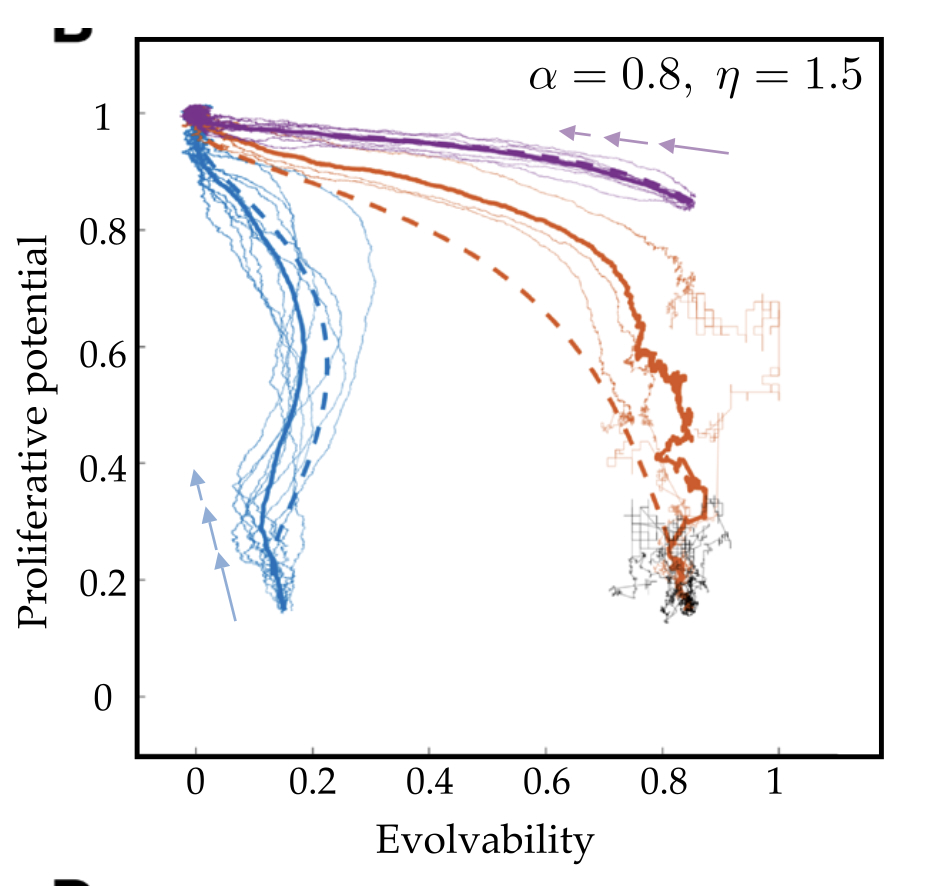
In a recent article published in Bulletin of Mathematical Biology, the researchers studied evolvability as a phenotypic trait subject to evolution and discussed its implications in the adaptation of populations of asexual individuals. They explored the evolutionary dynamics of an actively proliferating population of individuals, subject to changes in their proliferative potential and their evolvability, through mathematical simulations of a stochastic individual-based model and its deterministic continuum counterpart. The research lead to the discovery of robust adaptive trajectories that rely on individuals with high evolvability rapidly exploring the phenotypic landscape and reaching the proliferative potential with the highest fitness. The strength of selection on the proliferative potential, and the cost associated with evolvability, can alter these trajectories such that, if both are sufficiently constraining, highly evolvable populations can become extinct in our individual-based model simulations. The paper explores the impact of this interaction at various scales, discussing its effects in undisturbed environments and also in disrupted contexts, such as cancer.
https://doi.org/10.1007/s11538-025-01561-8