
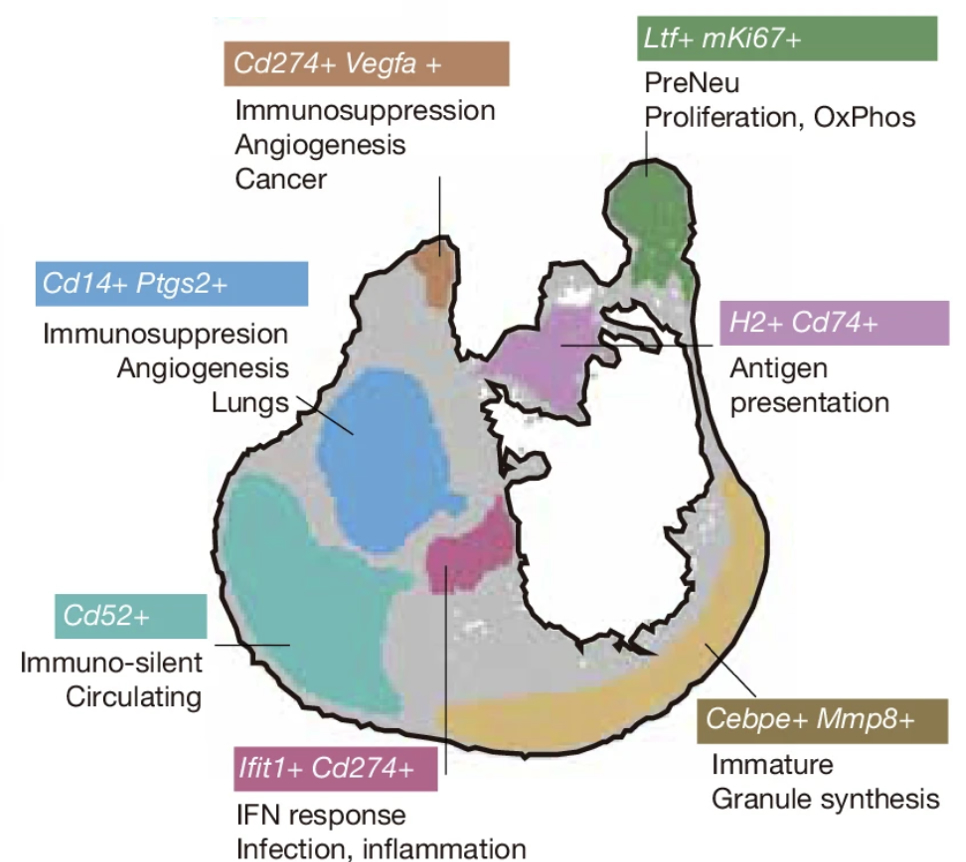
An international team has published NeuMap, the first atlas revealing the global architecture of neutrophils, showing how this “first line of defense” reorganizes to protect, remember, and heal. Neutrophils are the most abundant immune cells and the first responders to infection or tissue damage. Despite their importance, until now little was known about how they function across different tissues or how they contribute both to protection and to diseases such as inflammation, cardiovascular disorders, cancer, or severe COVID-19.
To address this complexity, an international consortium including the Spanish National Center for Cardiovascular Research (CNIC), Universidad Carlos III de Madrid, Yale University, Westlake University (China), and the University of Castilla-La Mancha developed NeuMap, the first global map describing how neutrophils are organized across tissues, life stages, and disease conditions. Published in Nature, the study analyzed over one million cells using state-of-the-art sequencing technologies. Although individual neutrophils live only a few hours, their population maintains a remarkably stable architecture throughout life—a pattern emerging from apparent biological chaos.
Cross-species comparisons revealed that many cellular programs are highly conserved between mice and humans, accelerating clinical translation, biomarker discovery, and therapeutic development. Beyond organizing a previously fragmented field, NeuMap provides a practical tool to identify which neutrophil types are present in each disease and their functional roles.
MOLAB researchers Gabriel F. Calvo and David G. Aragonés contributed mathematical, computational, and data-analysis support, strengthening a successful collaboration that has already produced multiple high-impact publications.
Cerezo-Wallis, D., Rubio-Ponce, A., Richter, M. et al. Architecture of the neutrophil compartment. Nature (2025).
https://doi.org/10.1038/s41586-025-09807-0

|

|

|

|

|